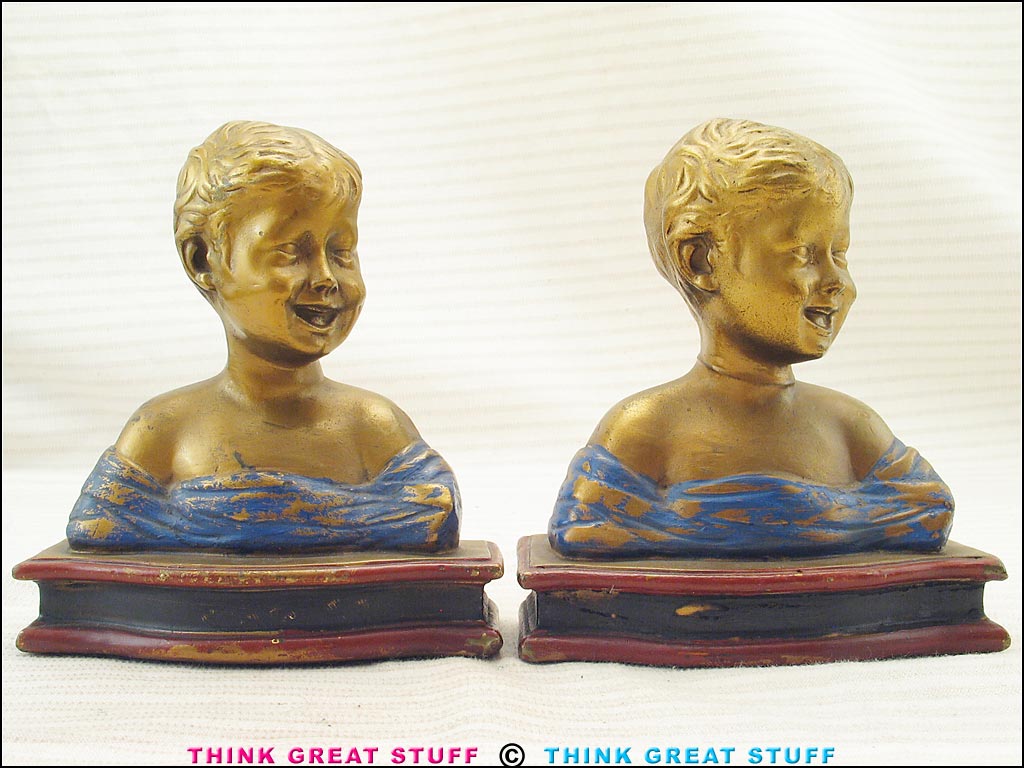



Simply charming, “Laughing Boy” made circa 1925 by the Armor Bronze Co, a pair of vintage electroformed bronze-clad figural book ends, with original polychrome paint (gold, blue, red, and black).
Although the figure and manner of dress may look feminine, these bookends are a version of a classic Renaissance work of art titled "Laughing Boy" by Desiderio da Settignano; and since this artist was heavily influenced by the work of Donatello, “Laughing Boy” is often attributed to Donatello. Plate No. 632 in Kuritzky and De Costa.
SPECS: Each measures about 7.2 tall by 6.4 wide by 2.7 inches deep. The pair weigh in at 5 lbs 10 oz. No breaks or cracks in the bronze-clad, although there are some dents. Shopmark cast into the back: "Circle in a Shield" (Armor Bronze). The original Armor Bronze foil labels are still affixed to each on the bottom, which reads: "The Armor Bronze Company, New York City".
~
Kunsthistorisches Museum Vienna, Laughing Boy: “The representation of children belongs among the most charming motifs revived by Renaissance art under the influence of Hellenism. Like a number of similar statuettes of equally unaffected charm, this one is probably the portrait of a child conceived as the infant Jesus. Such statuettes were commissioned to be set up in private chapels. The Laughing Boy is considered to be the last work of Desiderio da Settignano, who died young in 1464.” See also: Donatello